
Merriam-Webster.com defines “work-to-rule” as “the practice by workers of refusing to do any work that is not strictly required as a part of their jobs in order to protest something (such as unfair working conditions).”
Well, that’s too harsh for my purposes. But it hints at the main idea: when you have a deadline or a specified number of hours you’re authorized to spend on a project, there’s a limit to the amount of fussing you can do, and if you find yourself running out of time, you might have to start ruthlessly eliminating the optional stuff.
Much of the more granular styling and formatting that we can’t resist doing is gratuitous. This is what I mean by “the optional stuff”: stylings that few readers will notice, fewer still will care about, and some would even say are wrong. Reworking an alphabetized list into word-by-word style instead of letter-by-letter. Deleting all the periods after the letters in initialisms. Removing commas from in-text citations (Jones, 2012). Changing bulleted lists to numbered.
For many editors, to leave any amount of fiddling unfiddled goes against the grain. They see it as “cutting corners” or “sacrificing quality.” They’re the ones who pull all-nighters, work till the carpal tunnel snaps, and ask for extensions if every little detail isn’t yet just so. They ignore the section of the style guide that (like CMOS in the preface to the first edition) says, “Rules and regulations such as these, in the nature of the case, cannot be endowed with the fixity of rock-ribbed law. They are meant for the average case, and must be applied with a certain degree of elasticity.”
It’s not cutting corners to omit unnecessary work. If an editor is paid by the hour and has been given an estimate of how long a job should take, it can be the honorable thing to do. And jettisoning a time-consuming but optional styling task does not have to mean sacrificing quality. A good editor will already have made sensible judgments and prioritized editing tasks so that the important ones got done. Your doing unnecessary tasks and going over budget will not always be appreciated by a supervisor.
Editors who don’t have the authority to make certain styling decisions can at least ask the boss, “Is it necessary for dates to be formatted as month-day-year?” or “Is it important to sentence-cap all table titles?” Many supervisors will say “No—I’d rather you not exceed the estimated budget. If you don’t have time, don’t do it.” If the answer is yes, that the work must be done, fine. Then you can feel good about taking the time.
Of course, it’s best not to get into trouble over a deadline in the first place. Here’s how to pace yourself:
If your editing assignment has a time estimate attached, divide the number of estimated project hours (let’s say 75) by the number of working days before the deadline (let’s say 15) to figure out how many hours a day you need to do:
75 hours ÷ 15 days = 5 hours per day.
Next, figure out how many words an hour you have to cover in order to finish on time: divide the number of words (let’s say 150,000) by the number of estimated hours (75) to get words per hour:
150,000 words ÷ 75 hours = 2,000 words per hour. (In a 5-hour day, that would be 10,000 words per day.)
Add in a fudge factor if you are also doing nonediting tasks like corresponding with the writer or coding or cleanup.
Over time, you will learn from those numbers right up front whether you’re going to have to work faster than usual—your cue to avoid or query complicated styling chores. But for now, keep track of the number of words you edit each day. If you fall behind, start looking for ways to economize. Abandoning a laborious styling change midstream might mean going back to undo some work—it’s a judgment call as to whether it will save time.
Over the years, I have supervised many freelance editors. It’s always interesting to see how close their invoices come to the number of hours I estimated. It’s rare that someone exceeds the estimate, and I suspect that it’s because editors tend to short themselves. Instead of working to rule, they stay up late, get up early, ignore the kids or the dog, eat poorly, and burst into tears when someone asks how they are—all because of a self-imposed pressure to impose a million little optional style changes.
And that’s not right.
_____
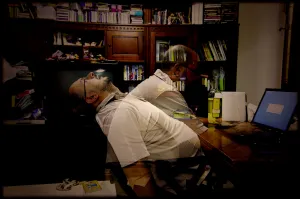
Photo: Stress, by Giuseppe Savo
This post originally appeared at The Chicago Manual of Style Online Shop Talk blog on September 1, 2015, © University of Chicago.